

How to Choose an SEO and AI Search (GEO and AEO) Agency in the UK: Questions to Ask, Red Flags and a Scoring Checklist
Choosing an SEO agency used to be hard enough. Now every agency also claims it can get you into ChatGPT, Gemini and Google’s AI Overviews. This guide shows you what good work looks like, which promises to run from, and the questions that separate the two.
Quick answer
To choose an SEO and AI search agency in the UK, check that they cover four jobs (technical health, useful content, outside proof and honest measurement), explain every change they make, and follow Google’s spam policies. Walk away from anyone who guarantees rankings or AI mentions, sells link packages, keeps their methods secret or plans to publish AI content at scale with no review. Ask how they will measure AI visibility, expect months of work before clear results, and score each agency on the checklist below before you sign.
What should an SEO and AI search agency actually do?
The work splits into four jobs. A good agency can explain each one in plain words and show you where it fits in their plan.
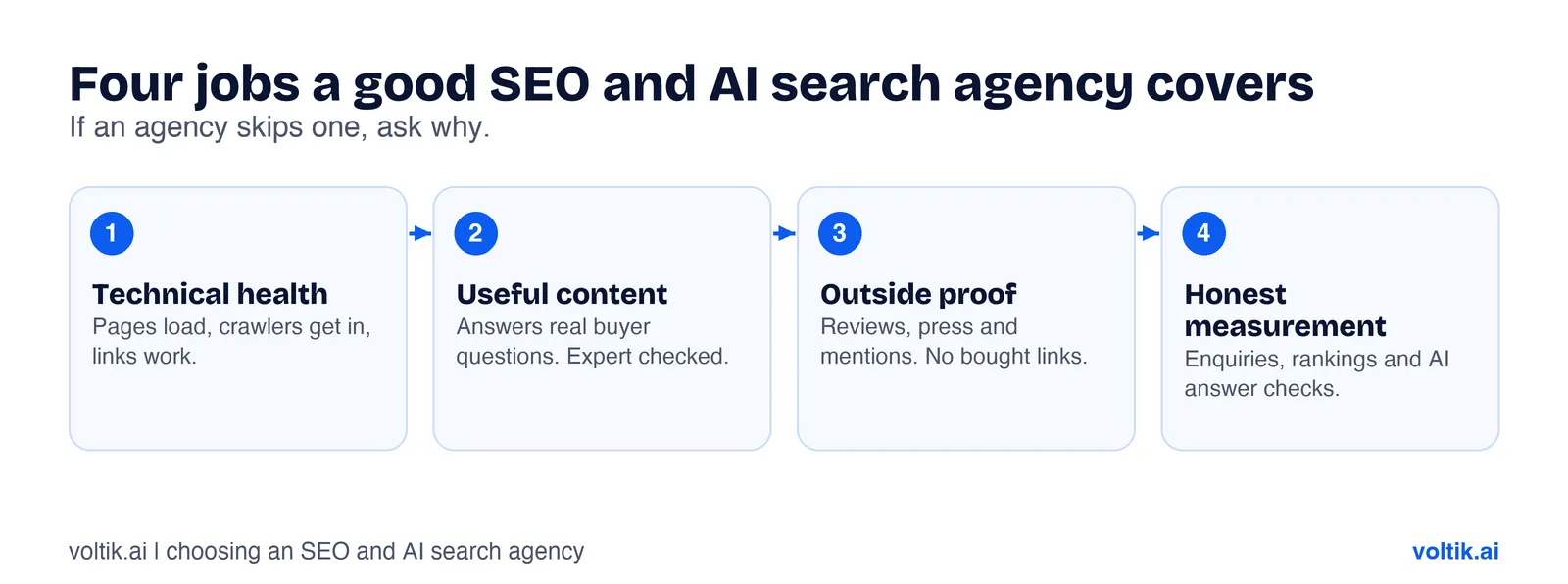 Four jobs. If an agency skips one, ask why.
1. Technical health. Search engines and AI tools must be able to reach and read your pages. That means pages that load, sensible redirects, clean internal links and nothing blocking crawlers by mistake. Google’s guide on AI features lists the same kind of basics: allow crawling in robots.txt and at your hosting or CDN level, make content easy to find through internal links, and keep important content in text form.
2. Useful content. Pages that answer the questions your buyers ask, written by or with people who know the subject. Google’s own list of what an SEO can do includes reviewing site content or structure, content development and keyword research.
3. Outside proof. What other people say about you: reviews, press, directory listings, talks, guest articles and mentions by trusted sites. This is the slow part, and it is where shortcuts tempt agencies most. More on that below.
4. Honest measurement. Reports that link the work to enquiries, with rankings, Search Console data and AI answer checks on top. If the only number is traffic, you cannot tell if the work is paying.
Our SEO vs AEO vs GEO guide explains the terms. The short version: GEO and AEO are names for getting named and described correctly in AI answers. They sit on top of SEO and do not replace it.
Can any agency guarantee rankings or AI citations?
No. Google’s page “Do you need an SEO?” says it plainly: “No one can guarantee a #1 ranking on Google.” It goes further and tells you that if an agency guarantees first place, you should find someone else.
The same logic applies to AI answers, and for a simple reason. The agency does not control the system that picks the answer. Google’s guide to AI features says that to appear as a supporting link, a page must be indexed and eligible to show with a snippet, and that indexing and serving are not guaranteed. In our experience, AI answers also change from one run to the next, so even a mention you see today may not show up tomorrow.
What an agency can promise is the work: a clear plan, done to a standard, with honest reports. That is what your money should buy.
What are the red flags?
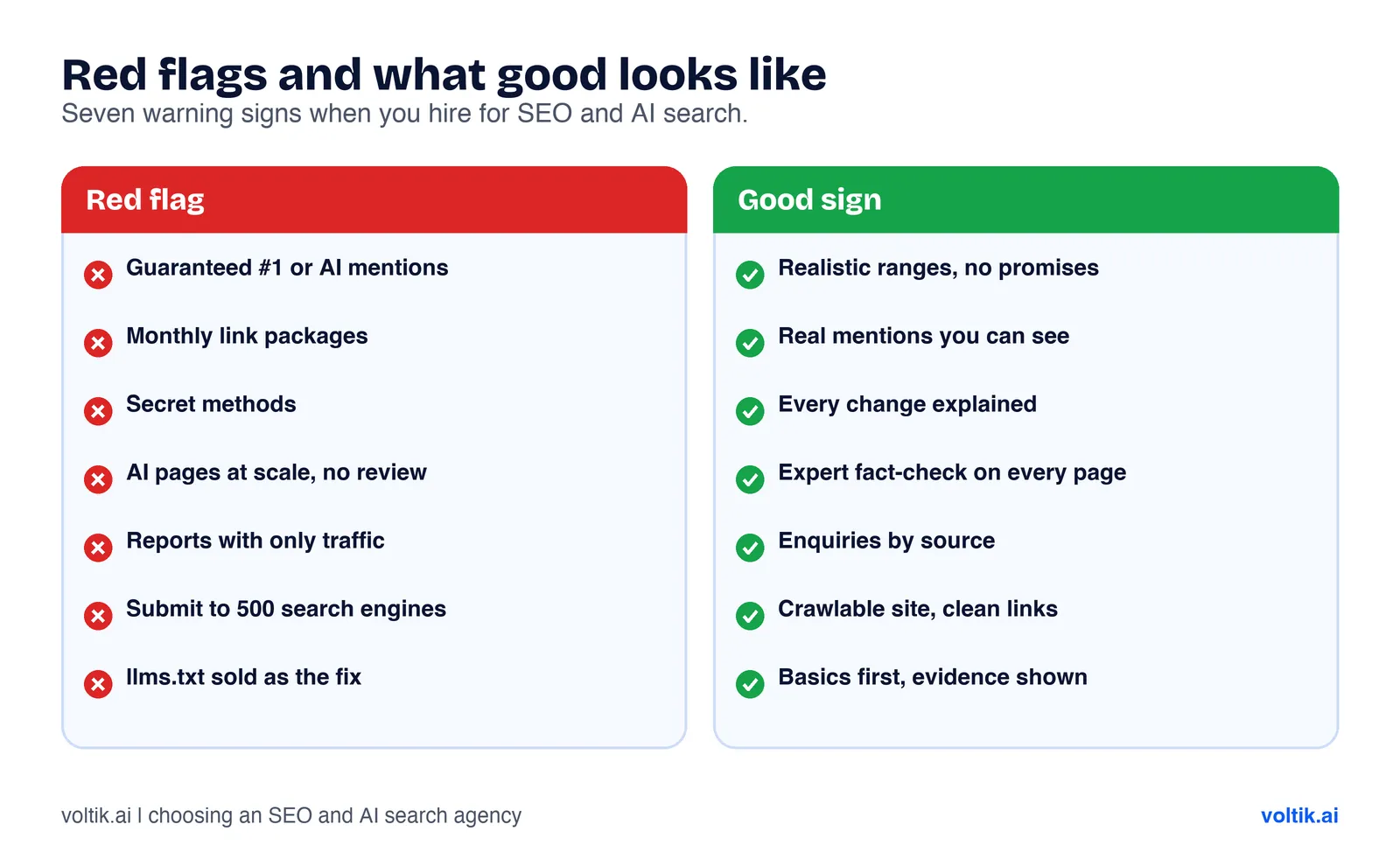 Seven warning signs, and what to look for in their place.
“We guarantee page one” or “We guarantee ChatGPT mentions.” See above. Google warns against SEOs who claim to guarantee rankings, claim a “special relationship” with Google, or advertise a “priority submit” to Google.
Link packages. “50 high authority backlinks a month” is a product, and Google treats it as a problem. Its spam policies define link spam as creating links mainly to manipulate rankings. The examples include buying or selling links for ranking, swapping goods or services for links, and using automated programs to build links. Google says sites that break its policies may rank lower or not appear at all.
Secret methods. Google’s advice is to be careful with any company that is secretive or will not clearly explain what it intends to do. A good agency should explain every change it makes and why.
AI content at scale. Google does not ban AI-assisted writing. Its guidance says the work must meet the Search Essentials standards, that AI output can contain mistakes, and that all AI-generated content should be fact-checked and reviewed by a person before it goes live. Using AI to churn out many pages that add nothing for readers may break the scaled content abuse policy. Google says that policy applies no matter how the content is made.
Renting space on someone else’s site. Some offers involve placing your content on a big, trusted website to borrow its standing. Google’s site reputation policy covers third-party content published on a host site mainly to use the host’s established ranking signals. Ask exactly where any content about you will be published.
Reports with only traffic. Visitors from the wrong searches will never buy. Ask for enquiries by source, rankings for buying searches and AI answer checks next to traffic.
“We submit you to 500 search engines.” Google tells you to avoid SEOs who talk about submitting your site to thousands of search engines. Google finds sites by crawling links. Submission packages belong to a much older web.
llms.txt as the magic fix. An llms.txt file is cheap to add and may do little harm. Selling it as the answer to AI visibility is a red flag. Google’s AI features guide says there are no additional requirements and no special optimisations needed to appear in AI Overviews or AI Mode, and no special schema to add. Our article does llms.txt work? covers the evidence.
How can AI search visibility be measured honestly?
There is no single number. Be wary of any agency that shows you one score with no method behind it. Honest measurement combines a few sources, and the agency should say what each one can and cannot tell you.
Search Console. Google’s AI features guide says traffic from AI features is part of overall search traffic and shows in the Performance report under the “Web” search type. So you see it, mixed in with the rest.
A fixed prompt list. Write the questions your buyers ask, run them on ChatGPT, Perplexity and Gemini on a set schedule, and log whether you are named, linked and described correctly. Answers vary, so track trends over months. Our guide on how to track AI visibility shows the method step by step.
Enquiries. Add “How did you hear about us?” to your forms and calls. In our experience, buyers who found you through an AI tool often say so, even when the analytics cannot see it.
Paid tracking tools. They automate the prompt checks. Ask the agency which prompts they track, how often, and from which location. A tool is only as good as the prompt list behind it.
If your firm is missing from AI answers today, start with why is my business not showing up in ChatGPT? before you hire anyone.
What questions should you ask an SEO and AI search agency?
Our guide to choosing a marketing agency covers the general questions about team, ownership, contracts and money. The ten below are specific to SEO and AI search. Google’s own list is a good start too: it suggests asking for examples of past work, whether they follow the Google Search Essentials, what results they expect and in what timeframe, and whether they will share every change they make to your site.
1. What will you change first, and why? Good: “A crawl and Search Console review found these three problems. We fix them first because they block everything else.” Bad: “Our proven 12-step process.” The same plan for every client.
2. Do you follow Google’s Search Essentials and spam policies? Good: “Yes. Here is how we build links and how we use AI in writing.” Bad: “Everyone bends the rules a bit.”
3. Where do your links and mentions come from? Good: Real examples: reviews, press, expert quotes, partners, events, guest articles that are clearly labelled. Bad: A monthly link count, or “our private network”.
4. How do you use AI in your content work? Good: “For research and drafts. A subject expert checks every fact and a person edits every page.” Bad: “We can publish 100 pages a month.”
5. Who writes the content, and how do you show expertise? Good: Named writers, quotes from your team, real examples, author pages. Our E-E-A-T guide for expert content explains why this matters. Bad: “Our writers can cover any topic.”
6. How will you measure AI visibility? Good: A written prompt list, a schedule, the platforms checked and the limits of the method. Bad: One “AI score” with no method behind it.
7. What will the monthly report show? Good: Work done, changes to the site, rankings for buying searches, Search Console trends, AI answer checks, and enquiries by source. Bad: Traffic and a list of “keywords improved”.
8. What results do you expect, and by when? Good: A range, with the reasons it might be slower or faster, and early signs to watch. Bad: A guaranteed position or a fixed number of leads.
9. What do you need from us? Good: Time with your experts, access to Search Console and analytics, approval of content, help with reviews. Bad: “Nothing, we handle it all.” Good content needs your knowledge.
10. If we part ways, what do we keep? Good: Everything. Content, accounts, data and reports stay yours. Bad: Links or pages that disappear when you stop paying.
How long should SEO and AI search take?
Google’s guidance does not give a fixed timeline. It tells you to ask the agency what results they expect and in what timeframe. So treat any timeline as a working estimate. This is roughly how we plan the work in our experience, and every site is different.
| When | What happens | What you should see |
|---|---|---|
| Month 1 | Audit, fixes, tracking, prompt list | A written plan and a baseline |
| Months 2 to 3 | Core pages improved, first new content, proof work starts | Pages indexed, changes logged |
| Months 4 to 6 | More content, more outside mentions | Early movement on buying searches |
| Months 6 to 12 | Keep going, cut what is not working | Clear trends in rankings, AI answers and enquiries |
Google also says a great time to hire an SEO is when you are planning a site redesign, and the earlier the better. Fixing structure at the start costs less than fixing it later.
A scoring checklist you can copy
Score each line 0, 1 or 2 after your calls. 0 means no or a bad answer. 1 means partly. 2 means a clear, specific answer with proof.
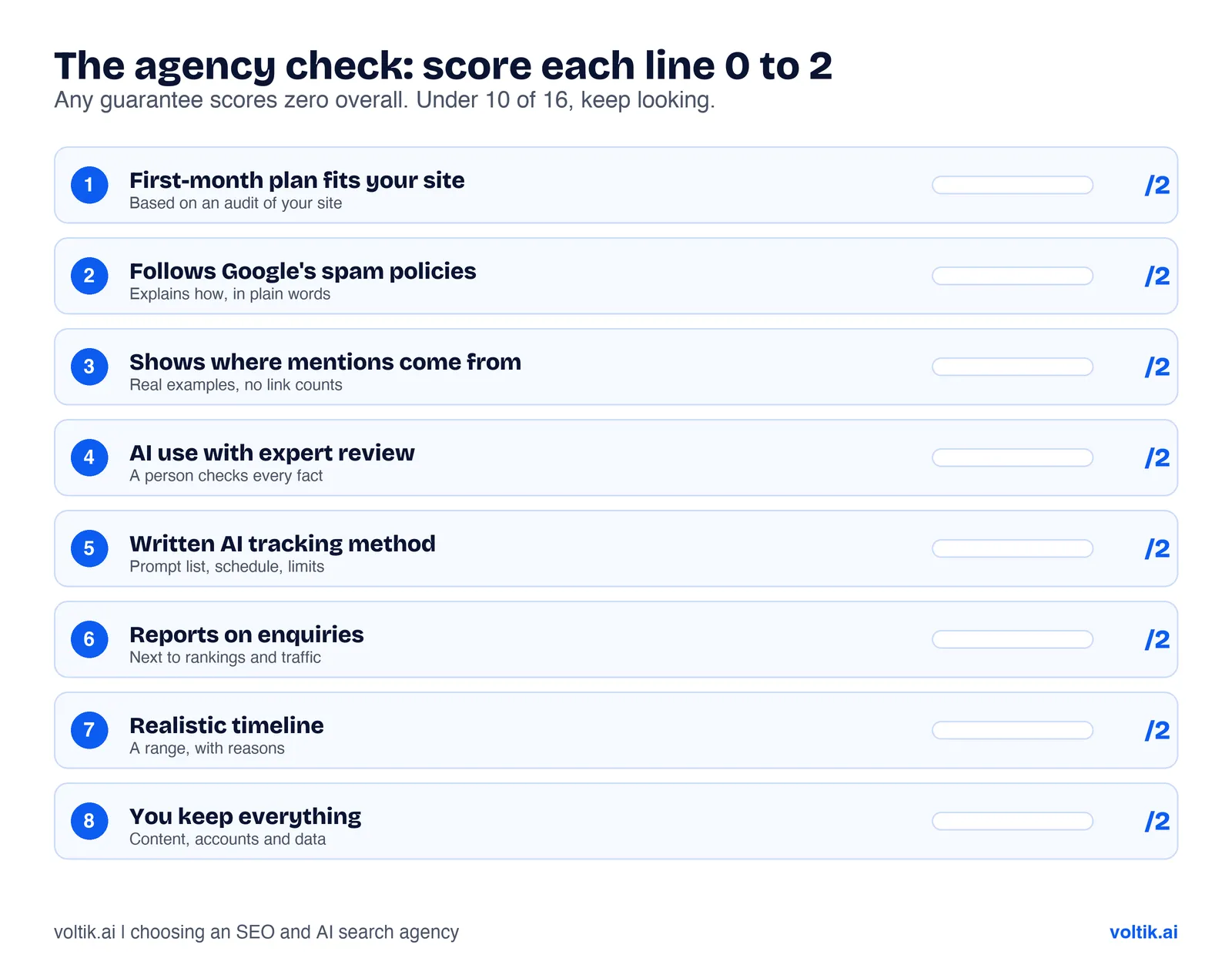 Score every agency on the same eight lines, then compare totals.
| Check | Score (0 to 2) |
|---|---|
| Explains a first-month plan specific to your site | |
| Follows Google’s spam policies and says how | |
| Shows where links and mentions will come from | |
| Uses AI with expert fact-checking and human editing | |
| Has a written method for tracking AI visibility | |
| Reports on enquiries, along with rankings and traffic | |
| Gives a realistic timeline with no guarantees | |
| You keep all content, accounts and data | |
| Total (out of 16) |
Any guarantee of rankings or AI mentions means the agency scores zero overall, whatever else they say. Below 10 out of 16, keep looking. For a hands-on view of the work itself, our AI search optimisation checklist lists every task.
Where Voltik fits, and when we are the wrong choice
We suit service firms, founders and experts who sell on trust and want SEO and AI search tied to real enquiries. We work best when SEO sits next to the website and the follow-up, because traffic only matters if the site turns it into conversations. We name who does the work, explain every change, and you own everything we make.
We are the wrong choice if you want a guaranteed position or a fixed number of AI mentions, because nobody can honestly promise those. We are also the wrong fit if you want a large volume of pages each month with little input from your team, or if you need a big in-house team in another country for a multi-market rollout. If you only need a quick technical fix and nothing more, a freelance technical SEO may suit you better.
Questions people ask
What is a GEO agency?
A GEO (generative engine optimisation) agency works to get your business named and described correctly in AI answers from tools like ChatGPT, Gemini, Perplexity and Google’s AI Overviews. Good GEO work builds on normal SEO.
Can an agency guarantee my business will appear in ChatGPT?
No. The agency does not control how AI tools choose answers, and answers change between runs. Google says no one can guarantee a number one ranking, and the same caution applies to AI answers.
Is AI-written content bad for SEO?
Not by itself. Google says content must meet its Search Essentials standards and should be fact-checked and reviewed by a person. Using AI to mass-produce pages that add no value may break its scaled content abuse policy.
Do I need separate agencies for SEO and AI search?
Usually not. Google says SEO best practices remain relevant for its AI features. One team that covers technical health, content, outside proof and measurement can handle both.
How long before I see results from an SEO agency?
There is no fixed answer, and Google suggests you ask each agency what they expect and when. In our experience, early signs often show within a few months and clearer trends take longer.
What should be in a monthly SEO report?
Work done and changes made, rankings for searches that bring buyers, Search Console trends, AI answer checks against a fixed prompt list, and enquiries by source.
Sources
- Google Search Central, “Do you need an SEO?”, Google Search documentation, accessed November 2026.
- Google Search Central, “Spam policies for Google web search”, Google Search Essentials, accessed November 2026.
- Google Search Central, “AI features and your website”, Google Search documentation, accessed November 2026.
- Google Search Central, “Google Search’s guidance on using generative AI content on your website”, Google Search documentation, accessed November 2026.
Want a second opinion before you sign?
We run SEO and AI search optimisation for UK service firms, with the website and follow-up work alongside. If you have proposals on the table and want an honest view of them, or want to see where your site stands in Google and AI answers today, book a free call.
Work with us