

How Long Does AI Search Optimisation Take, and Why Does ChatGPT Not Show Your Changes Yet?
How long does it take before ChatGPT, Gemini and Google’s AI Overviews start naming your business? Usually months, and the work keeps building after that. This guide explains why the answers do not change the week after your set-up, why asking ChatGPT about your own company is a poor test, and how to measure progress properly.
Quick answer
AI search optimisation usually takes months to show steady results, and it keeps building after that. In our experience, technical fixes can take effect within days or weeks, early mentions for specific questions often appear in the second or third month, and a reliable presence across many buyer questions tends to come from four to six months of steady work. ChatGPT may not show your changes yet because it often answers from what it learned in training, it only searches the web when it decides to, answers vary from run to run, and your own chat history shapes what you see. Set-up makes you eligible. Monthly work on content, mentions and measurement is what earns the mentions.
Why has ChatGPT not changed since our set-up?
Because the set-up opens doors, and it takes time for anything to walk through them.
The set-up let the right crawlers in, made your pages readable to machines and published your first answers. All of that is necessary. None of it forces an AI tool to rewrite what it says about you the next morning.
There are four reasons the answer stays the same for a while.
1. ChatGPT does not always search. OpenAI’s help page on web search says ChatGPT “may search the web automatically when your question would benefit from current information”. A simple question like “tell me about [company]” can be answered from what the model learned in training. OpenAI’s page “Does ChatGPT tell the truth?” says the models are trained on data up to a certain point, and that answers do not include later events unless tools such as search are used. So your new pages may be live and readable, and still not be part of that answer.
2. Crawling and indexing take time. OpenAI’s crawler documentation says it can take about 24 hours for its systems to adjust after a robots.txt change. That is only the door opening. Google’s own help page on recrawling says crawling “can take anywhere from a few days to a few weeks”. After crawling comes the slower part: being picked as a source.
3. Being found is different from being chosen. OpenAI’s help page says ChatGPT ranks search results using several factors and that “placement is not guaranteed”. When it does search, it often rewrites your question into one or more shorter queries and sends them to search partners. Your page has to be a strong match for those queries and look more trustworthy than the alternatives.
4. Trust is built off your site. AI tools lean on what other sources say. A firm with a fresh, well-built website and few mentions elsewhere still looks new to a machine. Mentions on other sites build over months.
None of this means the work has stalled. It is happening where a chat window cannot show it. For the full list of things that hold a business back, see our guide to why your business is not showing up in ChatGPT.
Why is searching your own name a poor test?
Because the answer you see is shaped around you, and your buyer sees a different one.
AI assistants personalise. OpenAI’s Memory help page says that when Memory is on, ChatGPT can use past chats, saved memories, custom instructions and connected apps to personalise responses. Its web search page adds that ChatGPT works out a general location from your IP address, and that saved memories can be used when it rewrites a search query.
If you have talked to ChatGPT about your company for weeks, it may remember your role and the way you describe your firm. It knows roughly where you are. Every check you run becomes part of your own history. The person who will hire you has none of that. They have their own history, their own location, and they almost certainly phrase the question differently.
Google works the same way. Its help page on why results differ lists personalisation, location, language, device and even which data centre answers the search.
There is a second problem. Your buyers rarely ask “tell me about [your company]”. Before they know your name, they ask things like “who should I use for this in London?” or “what does this cost for a firm our size?” Those unbranded questions are where new business is won, and they are the ones a daily name check never tests.
The third problem is chance. SparkToro, working with Gumshoe.ai, had 600 volunteers run 12 prompts through ChatGPT, Claude and Google’s AI, 2,961 times in total, in November and December 2025. They published the results on 28 January 2026. They found less than a 1 in 100 chance that ChatGPT or Google’s AI would give the same list of brands twice in 100 runs, and lists in the same order came up roughly once in 1,000 runs. Gumshoe.ai sells AI tracking, and SparkToro notes the possible conflict of interest. Even so, the lesson is clear: one answer, on one morning, in one account, is a single roll of the dice.
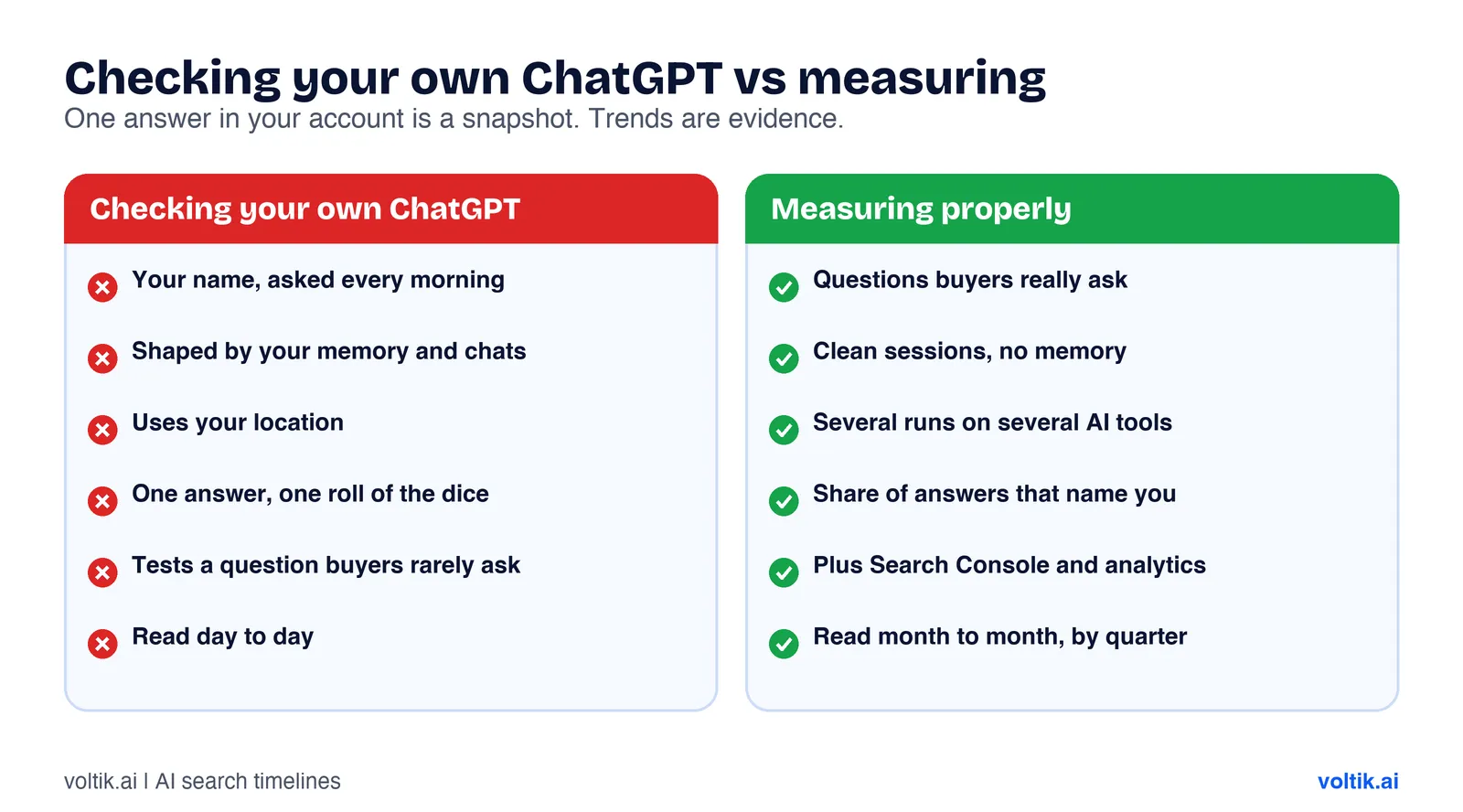 One answer in your own account is a snapshot. Trends across many answers are evidence.
How do AI tools decide which firms to mention?
No AI company publishes a full recipe, so treat anyone who claims to have it with care. What the official pages do tell us is enough to explain why patience pays.
They have to be able to reach you. OpenAI says sites opted out of its search crawler, OAI-SearchBot, will not be shown in ChatGPT search answers. Google says a page must be indexed and eligible to show with a snippet to appear as a link in AI Overviews or AI Mode.
They look for good matches to the question. Google says AI Overviews and AI Mode may use a “query fan-out” technique, running several related searches across subtopics to build an answer. ChatGPT also rewrites questions into shorter searches. A page that clearly answers one of those smaller questions can be picked up.
They follow the basics of good search. Google’s page on AI features says there are no special extra steps to appear in AI Overviews or AI Mode, and that normal SEO best practice still applies. Our article on SEO vs AEO vs GEO explains how the three fit together.
They weigh what others say about you. In our work, the firms that AI tools name most often are the ones discussed, quoted and listed on sites those tools already cite. That proof takes time to earn.
This is also why a single file like llms.txt is helpful housekeeping with limits. We looked at the evidence in does llms.txt work?
What does a realistic timeline look like?
This is our working estimate from client work, and it is not a promise. Every market, starting point and level of competition is different. Google’s own guide “Do you need an SEO?” suggests asking any agency what results to expect “and in what timeframe”, which is a fair question. Here is our honest answer.
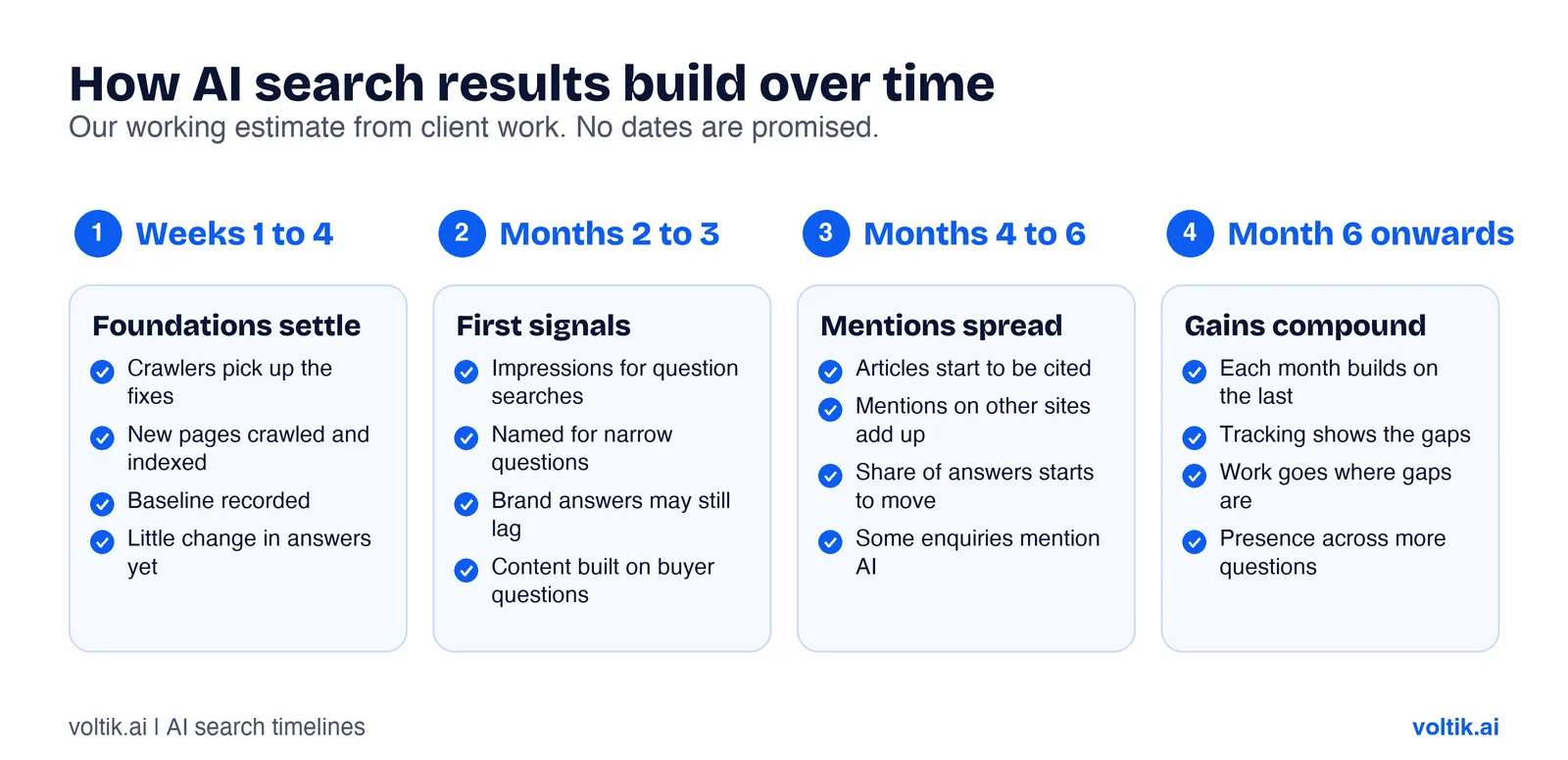 Our working estimate from client work. Your market may move faster or slower.
Weeks 1 to 4: the foundations settle. Crawlers pick up the fixes. Google crawls and indexes the new pages, which its help page says can take days to weeks. A baseline is recorded, so later change can be proven. Very little changes in AI answers yet. That is normal.
Months 2 to 3: the first signals. Search Console starts to show impressions for longer, question-style searches. Your firm may begin to appear in answers to narrow, specific questions, often before it appears for broad ones. The answer to “tell me about us” may still lag behind, because it can rely on older training data.
Months 4 to 6: mentions spread. Articles built around real buying questions start to be cited. Mentions on other sites begin to add up. Your share of answers across the tracked questions starts to move, unevenly at first. Some enquiries may mention that they found you through an AI tool.
Month 6 and beyond: the gains build on each other. Each new article, mention and update adds to what is already there. Tracking shows which questions you win and which you still miss, and the next month’s work goes where the gap is.
Is AI search a one-off project or ongoing work?
Both, in that order. The set-up is a one-off. The results come from ongoing work.
The questions buyers ask keep changing. AI tools change how they search and what they cite. Competitors publish too. A site set up well and then left alone slowly drifts, while firms that keep going pull ahead.
The ongoing work has five parts:
- Tracking the prompts buyers really use. A fixed set of buyer questions, checked on a schedule, so progress is visible and honest.
- Watching what people ask. Monitoring keywords and the questions people put to ChatGPT and Google in your field, as they shift.
- Creating content around real buying moments. Articles and pages built for the situations your ideal client is in when they start looking, written so AI tools can quote them.
- Updating the site from what tracking shows. Strengthening the pages that are close to being cited and fixing the gaps the numbers reveal.
- Earning mentions on other sites. Being quoted, listed and discussed in the places AI tools already trust. These off-site mentions are often what tips an answer in your favour.
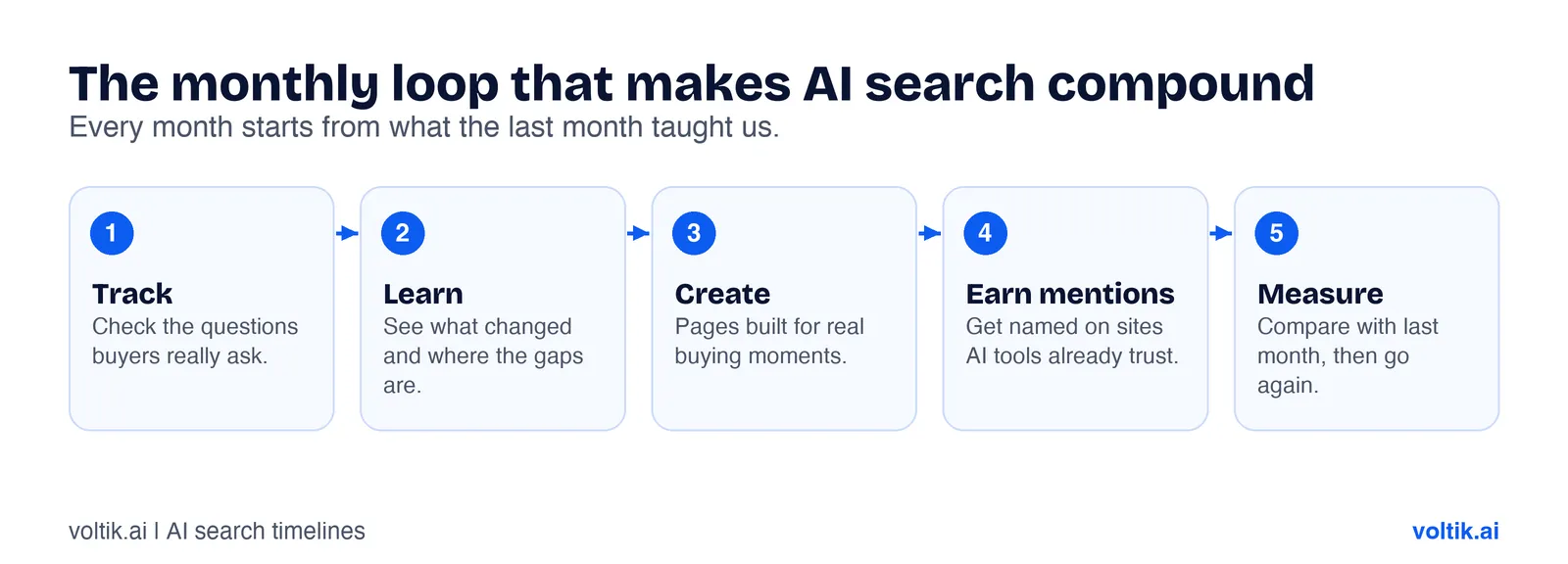 Every month starts from what the last month taught us. That is why the work compounds.
Why does it compound? A useful article keeps earning visits long after it goes live. A mention on a trusted site keeps vouching for you. Each round of tracking aims the next round of content better. Month six does more than month one, because there is more to build on and more evidence of what works.
How should you measure progress instead?
Swap the morning check for a handful of measures that reflect what buyers see. Our guide on how to track AI visibility in ChatGPT, Perplexity and Gemini goes into more depth.
- A fixed set of buyer questions, run on a schedule. The same questions, asked in clean sessions with no memory or past chats, several times each, on more than one AI tool. The number that matters is how often you appear across all of those answers. SparkToro’s research supports this: it found that visibility across many runs was a reasonable measure, while position in a single list was not.
- Search Console impressions. Google says traffic from AI Overviews and AI Mode is included in the Performance report in Search Console. Rising impressions for question-style searches are an early sign that the content is being seen.
- Visits from AI tools. Your analytics can show people arriving from ChatGPT, Perplexity, Gemini and similar tools. The numbers start small. The trend is what counts.
- Enquiries that mention AI. Ask new leads how they found you. “ChatGPT suggested you” is the most direct proof there is.
- Mentions on other sites. A growing count of quotes, listings and articles that name you is the base everything else stands on.
Look at these monthly, and judge them over a quarter. Single weeks are too noisy to read.
What should you expect from an agency each month?
You should be able to see what was done, what changed and what happens next. In plain terms, a good monthly AI search service should give you:
- A visibility report showing how often you appear across a fixed set of buyer questions, compared with last month and with your starting point.
- New and updated content aimed at the questions your buyers are asking, with the reasons each piece was chosen.
- Progress on mentions on other sites, with what was earned and what is in progress.
- Search and analytics trends, including impressions, AI referrals and any enquiries that mention AI.
- A clear plan for next month, based on what the numbers show.
You should also expect honesty. Some months show big moves and some show quiet groundwork. A good agency tells you which is which, and never promises a ranking or a mention by a date, because nobody controls these systems.
What can you see in the first weeks?
A lot more than a chat window shows. The big prize, being named often by AI tools, takes months. But the work leaves a trail of early, checkable wins long before that. These are the ones we point clients to.
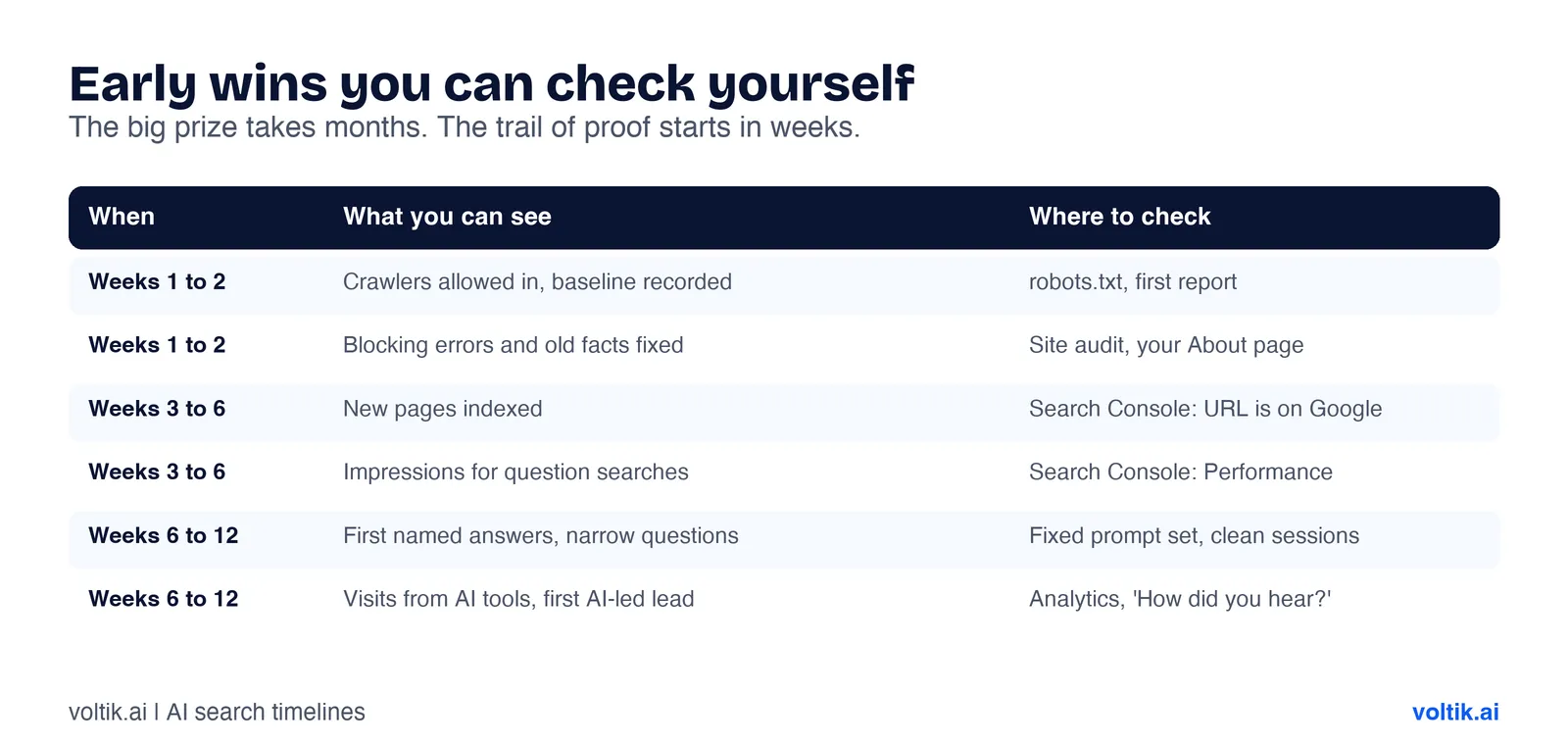 Early wins you can check yourself, long before AI answers settle.
In the first two weeks:
- The doors are open. Search engine and AI crawlers are allowed in, and you can see it in your robots.txt file and your server logs. OpenAI says its systems adjust to a robots.txt change in about 24 hours.
- Your starting point is on record. A baseline of how often you appear across a fixed set of buyer questions, on several AI tools. Without it, nobody can prove progress later.
- Problems are fixed that were quietly costing you. Pages that could not be crawled, missing titles, broken links, thin service pages and facts about your firm that were out of date or inconsistent across the web.
In weeks three to six:
- New pages are indexed. Search Console shows each new article as “URL is on Google”. Google says crawling can take from a few days to a few weeks, so this is often the first hard proof.
- Question-style searches start to show. Search Console begins to show impressions for longer searches, the kind people type when they are close to buying. Google says traffic from its AI features is counted in the same report.
- Wrong or old facts start to change. When an AI tool searches the web and finds clear, current pages about you, it has better material to quote. In our experience, answers that relied on old information are often among the first to improve.
In weeks six to twelve:
- The first named appearances, usually for narrow, specific questions before broad ones.
- Visits from AI tools start to appear in your analytics. Small at first.
- A sales conversation that mentions AI. Ask every new lead how they found you. The first “ChatGPT suggested you” is worth more than any chart.
None of these is the finish line. Each one is evidence that the engine is running, and that is what you should expect to see in every monthly report.
“It takes too long.” Answers to the questions we hear most
These are the honest answers to the worries founders raise with us, often in the first month. If you are feeling any of them, you are in good company.
Why should I wait months for results?
Because the thing you are building lasts. Most marketing stops working the moment you stop paying for it. A useful page that AI tools trust, and a mention on a site they already cite, keep working for you month after month without a fresh bill each time. The wait is the time it takes to build an asset, and the asset is what makes the wait worth it.
It also helps to compare the wait with the alternative. The questions your buyers ask AI tools are being answered today, with or without you. Every month you are absent, someone else’s name is the one being repeated.
Can you not just make it faster?
Some parts, yes. We front-load the work that pays soonest: fixing what blocks crawlers, correcting facts about your firm, and answering the narrow, high-intent questions first, because those tend to move before broad ones. What nobody can speed up is the part outside anyone’s control: how often a crawler returns, when an AI tool decides to search, and how quickly other sites mention you. Anyone who promises to skip that is promising something they do not control. Google’s own guide to hiring help warns against anyone who guarantees results.
How do I know it is working before the mentions show up?
By the trail of early wins above. Pages indexed, impressions rising for question-style searches, errors fixed, a baseline recorded and compared each month. If those are moving, the work is on track. If they are not moving after a couple of months, that is a fair question to put to your agency, and a good agency will want you to ask it.
My competitor is already being named. Is it too late?
No. AI answers are not fixed lists. SparkToro’s research found that AI tools rarely give the same list of brands twice. That cuts both ways: a competitor named today is not locked in, and a firm that keeps publishing clear answers and earning mentions can win a share of those answers over time. A competitor already being named is proof that buyers are asking, which is good news for you.
Can I stop after the set-up and pick it up again later?
You can, but you lose ground you have to win back. The questions buyers ask change, AI tools change how they search, and competitors keep publishing. A site that is set up well and then left alone slowly drifts. Restarting means rebuilding the baseline, catching up on the questions you missed and regaining momentum on mentions. Steady effort over months beats bursts with gaps in between.
Why not just put the money into ads instead?
Ads are a great tool for demand you can buy today, and we run them for clients. They stop the day the budget stops. AI search work builds something you keep. The two work well together: ads bring enquiries now while AI search builds the presence that makes those enquiries cheaper and warmer over time. If you need leads this month, ads can bridge the gap. Our guide to Meta ads for high-ticket B2B services covers when they fit.
What if it never works for us?
Then you should be able to see why, month by month, long before you have spent a year on it. That is the point of a baseline and a fixed set of buyer questions: progress, or the lack of it, is visible. In our experience, the firms that see the least movement are those with very little to say that is specific to them, or no time to give the expert input that makes content worth citing. Both are fixable, and both are worth knowing early.
Is AI search big enough to matter yet?
Your buyers are already using it. Google now shows AI Overviews and AI Mode in its own results, and Google says these features use the same pages and the same search basics as normal results. So the work is never wasted: the content that earns AI mentions also helps you rank in ordinary Google search. You are building for both at once.
What is the reward for being patient?
It is worth spelling out, because it is easy to forget in month two.
- Buyers arrive warmer. In our experience, someone who asked an AI tool for a recommendation and heard your name has already been half-sold by a source they trust. Those conversations tend to start further along.
- It compounds. Each article, mention and fix adds to the last. Month six does more than month one, and month twelve more than month six, because there is more for the AI tools to find and more proof of who you are.
- It keeps working when you stop paying for each click. A page that earns citations does not send a bill every time someone reads it.
- It helps Google rankings at the same time. Google says normal SEO best practice applies to its AI features, so the same work lifts both.
- Being early counts. The sources AI tools trust in your field are being settled now. Firms that build that presence first are the ones being repeated later.
In our experience, the firms that win in AI search are rarely the ones with the biggest budgets. They are the ones that kept going for long enough to be the obvious answer.
Questions people ask
How long does AI search optimisation take?
In our experience, technical fixes take days to weeks to be picked up, early mentions for specific questions often appear in months two to three, and steady visibility tends to come from four to six months of consistent work. It keeps building after that. Nobody can promise a date.
How long does it take ChatGPT to update information about my business?
OpenAI says its systems adjust to robots.txt changes in about 24 hours, but that only lets its crawler in. When ChatGPT answers from training data without searching, new information may not appear until a later model is trained. When it does search, your page still has to be chosen as a source.
Why is ChatGPT not showing my business?
Common reasons are a blocked crawler, pages machines cannot read, few mentions on other sites, or no page that answers the buyer’s question. Our guide on why your business is not showing up in ChatGPT walks through each one.
Is GEO a one-off or ongoing?
The set-up is a one-off. The results come from ongoing work: tracking buyer questions, creating content around them, updating the site and earning mentions elsewhere. Without that, a well set up site slowly loses ground to firms that keep going.
Why does ChatGPT give me a different answer from my colleague?
ChatGPT can personalise answers using memory, past chats and your general location, according to OpenAI’s help pages. Answers also vary by chance from one run to the next. Two people asking the same question will often see different results.
Sources
- OpenAI, “Searching the web with ChatGPT”, OpenAI Help Center, accessed November 2026.
- OpenAI, “Memory in ChatGPT”, OpenAI Help Center, accessed November 2026.
- OpenAI, “Does ChatGPT tell the truth?”, OpenAI Help Center, accessed November 2026.
- OpenAI, “Overview of OpenAI Crawlers”, OpenAI developer documentation, accessed November 2026.
- Google, “AI features and your website”, Google Search Central, accessed November 2026.
- Google, “Ask Google to recrawl your website”, Google Search Central, accessed November 2026.
- Google, “Do you need an SEO?”, Google Search Central, accessed November 2026.
- Google, “Why your Google Search results differ from others”, Google Search Help, accessed November 2026.
- Google, “Personalization & Google Search results”, Google Search Help, accessed November 2026.
- SparkToro (Rand Fishkin), “NEW Research: AIs are highly inconsistent when recommending brands or products; marketers should take care when tracking AI visibility”, SparkToro blog, 28 January 2026, accessed November 2026.
Want us to do this for you?
The set-up gets you to the starting line. We run the monthly work that follows: tracking the questions your buyers ask, writing the content that answers them, updating your site from what the numbers show and earning mentions on the sites AI tools trust, with a clear report every month. Read about our AI search optimisation service, see the AI search optimisation checklist, or book a free call and we will show you where you stand today.
Work with us