

Why Your Manufacturing Website Isn't on Google
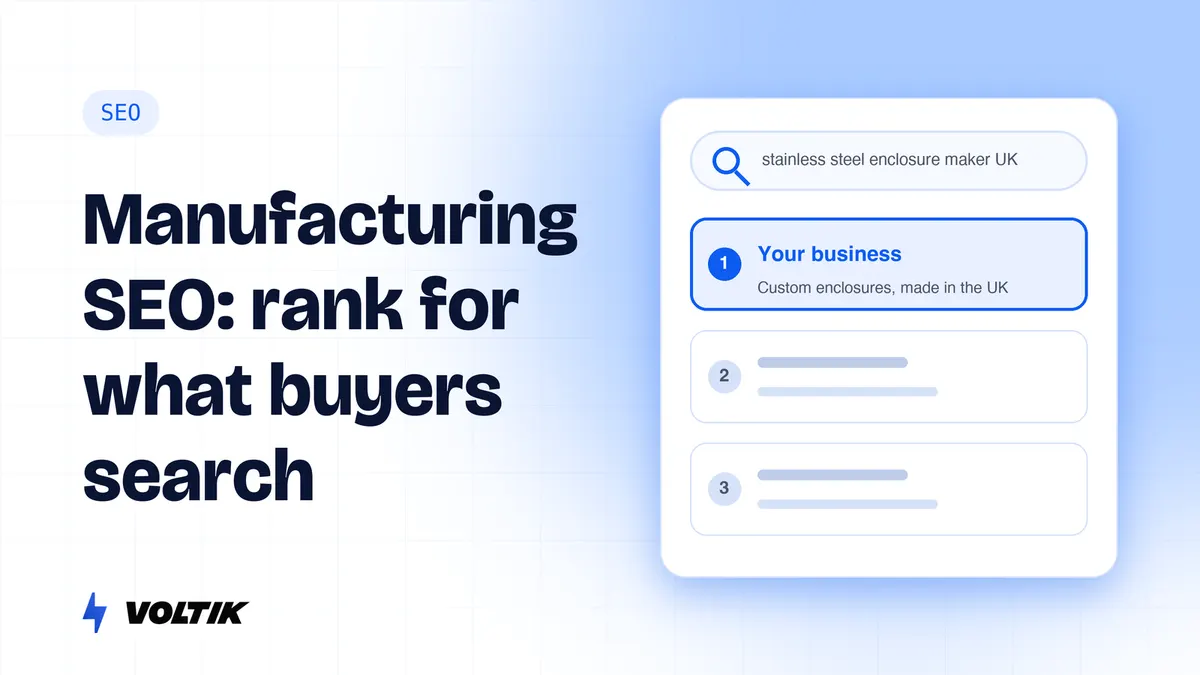
If your manufacturing website isn’t on Google, the reason is simple. Google can’t see how good your business is. It only reads your website. A smaller, newer competitor with a blog and real case studies gives Google more to read, so it ranks higher. Here’s why that happens, and how to rank on Google.
Try this. Open a private browser window (often called incognito) and type in the exact product you make. Leave your brand name out, just as a buyer would. Precision-machined brackets, powder coated steel fabrication, industrial packaging for the food sector, whatever it is.
There’s a chance your company isn’t on page one. It might not be on page two either. Somewhere near the top may sit a newer competitor. They might have a blog and a page of case studies with photos from actual jobs. And Google seems to rank them above you.
That’s a strange thing to sit with when you’ve spent fifteen or twenty years building something real. You’ve got the factory, the client list, the quality control, and the reputation that gets you repeat orders and referrals. They’ve got a website that’s newer than yours. And somehow that’s winning.
This isn’t a glitch, and Google hasn’t got it wrong. Google can’t see the things that make your business good. It can’t see how long you’ve traded, how many happy customers you have, or how solid your product is on the factory floor. It reads your website, plus links and mentions from other sites, and compares that with everyone else’s.
Why years in business don’t show up on Google by themselves
This is the part many MDs in manufacturing find hard to accept. Google can’t see that you have been in business since 2005 unless your website and the wider web show it. It doesn’t care that your website has “always worked fine” and never needed touching. A website that’s twenty years old, with five pages that never change (home, about, products, gallery, contact), gives Google almost nothing to work with.
Google wants evidence. That means specific pages that answer the specific questions a buyer is typing in. It means content that shows you understand a particular industry’s problem, and not only that you make a particular category of product. And it means a site that gets added to and updated, rather than one that was built once and left alone.
A newer competitor with a blog and a handful of case studies is publishing new, specific pages every month, using the words buyers actually search for. Your site, built once in 2012 and never touched since, is standing still while theirs keeps growing. For some searches, Google favours pages with fresh, relevant material. That has nothing to do with who’s the better manufacturer.
What do buyers do before they pick up the phone?
This part changes how you should think about your website. Your buyer isn’t calling you to “have a look.” By the time they call, they’ve mostly already decided.
The B2B buying platform 6sense surveyed nearly 4,000 B2B buyers who had made a big purchase in the last two years. It found that buyers get through around 61% of their buying journey on their own, before they first engage a vendor. In the same research, 94% of buying groups said they could rank their preferred vendors before first contact. About four in five went on to buy from the vendor they first spoke to.
In plain terms: your buyer is Googling your product category, reading a few company websites, quietly building a shortlist, and mentally ranking you against your competitors. All of that happens before you know they exist. If your website doesn’t turn up in that search, or turns up looking like it hasn’t been touched since 2013, you never get considered for the sale. You can’t lose a sale you never knew about.
Why do case studies help a manufacturing website rank and win work?
The consultancy Nebula audited 100 UK engineering and manufacturing websites from the Made in Britain directory. Only 40 of the 100 sites mentioned case studies anywhere in their public text. It was a small, non-random sample, and the audit checked for the phrase rather than reading every page, so the true figure may be higher. Even so, it suggests some UK engineering and manufacturing businesses give a prospective buyer little visible proof that they’ve solved this problem for someone else before.
That gap matters more than most owners realise. Storyblok is a software company that sells a content management system (the tool used to run a website). It reported that 46% of manufacturing decision-makers had switched suppliers because of poor website performance. It also reported that 79% prefer manufacturers whose websites are fast and easy to use. Storyblok did not share the sample size in its press release, so treat this as a guide.
Looking credible is only part of it. HubSpot has reported that companies that blog regularly get around 55% more website visitors, and cites DemandMetric research that they get 67% more leads. These are old figures and they show a link, not proof of cause. A blog still gives you more pages that can be found. It’s how you show up for the dozens of specific searches your one static “products” page will never rank for.
Why is a smaller competitor beating my manufacturing website on Google?
Put those two things together and the picture is clear. Your buyer decides most of their shortlist before contacting anyone. Google ranks pages using many signals, and specific, useful content is one you control. A newer competitor isn’t necessarily a better manufacturer than you. They may just have a website that does the one job a manufacturer’s website needs to do in 2026. It answers the questions a buyer types into Google, with evidence attached.
You have fifteen or twenty years of exactly the material that would win this. Every job you’ve quoted, every problem you’ve solved for a difficult customer, every product spec you know cold, that’s all content. It’s just sitting in your head, in old emails, and in a filing cabinet instead of on your website.
How can you get found on Google as a manufacturer?
You don’t need a full rebrand or a flashy new homepage. Most of the manufacturers we look at don’t need a different website. They need the one they have to start working. In practice that means:
- Product and service pages rewritten around the exact terms buyers search, using plain words and leaving out the internal jargon your team uses
- A steady flow of case studies, real jobs, real numbers, real photos, published on a schedule rather than as a one-off
- A blog that answers the specific technical and buying questions your customers ask before they ever contact you
- Basic technical fixes so the site loads fast and works properly on a phone, since a slow site is often silently costing you enquiries
- Updating and adding to the site regularly, instead of building it once and leaving it for a decade
None of this is complicated. Most of it is just work that a busy MD running a real manufacturing business has never had time to sit down and do.
That’s the gap Voltik exists to close for manufacturers like yours, turning fifteen years of proof you already have into a website that gets found.
Keep reading
Want to go further? Read 15 fixes so your website stops leaking enquiries, or see how Voltik helps you rank on Google on our service page.
Sources
- 6sense, “The B2B Buyer Experience Report for 2025”, 2025 (independent research share of the buying journey, and buying group shortlists).
- Nebula Marketing Consultancy, “What 100 UK Engineering Websites Tell Us About Turning Technical Expertise Into Enquiries”, published by SME Today, 25 August 2026.
- Storyblok, “Storyblok research finds 46% of manufacturing decision-makers have switched suppliers due to poor website performance”, 21 August 2024.
- HubSpot, “Blogging Statistics” (updated 7 July 2025), which cites DemandMetric for the leads figure.
Work with us