

How to Choose a LinkedIn Agency in the UK: A Buyer Guide to Ghostwriting, Personal Branding and Outreach for Founders and Teams
Hiring a LinkedIn agency means handing someone your name. If they get it right, buyers start to know you before the first call. If they get it wrong, your profile fills with posts you would never say, and your account can end up restricted. This guide shows how to tell the two apart before you sign.
Quick answer
To choose a LinkedIn agency in the UK, check five things. First, they put value first: every post, comment and message should be useful to the person reading it. Second, they protect your account. LinkedIn’s User Agreement bans unauthorised automation and its policies ban engagement pods, so any outreach tool must be used selectively, at a slow pace, with messages written for each person, or you risk a restriction or ban. Third, the writer interviews you, every post sounds like you, and you approve what goes out under your name. Fourth, they report conversations, meetings and inbound from the right people, with impressions as a side note. Fifth, you can leave on short notice and keep everything they wrote. Expect the first 90 days to build voice, profile and rhythm before results show.
What does a LinkedIn agency actually do?
Most LinkedIn agencies sell some mix of five jobs. Ask which ones are in the price, because the word “LinkedIn” covers very different work.
- Positioning. Who you want to reach, what you want to be known for, and the three or four topics you will own.
- Profile. Headline, About section, banner and Featured links, rewritten so a buyer understands what you do in ten seconds.
- Content. Posts drafted from interviews with you, edited until they sound like you, then approved by you.
- Engagement. Thoughtful comments on the posts your buyers read. Our LinkedIn commenting strategy explains why this often matters as much as posting.
- Outreach. Connection requests and messages to people who fit your buyer profile, sent by a human, at a pace a human would keep.
Some agencies also run the company page. For most service firms, people’s profiles do more of the work. Our guide to the LinkedIn company page vs personal profile explains why, and the LinkedIn personal branding playbook shows the whole method.
Common mistake: buying “content” when the real gap is outreach, or the other way round. Decide whether you need to be known, or need conversations now. Most firms need both, in that order.
What does LinkedIn itself allow?
This part protects your account, so we read LinkedIn’s own pages. Anyone selling you LinkedIn services should know them well.
Bots and automation. LinkedIn’s User Agreement lists things you agree not to do. One is using bots or other unauthorised automated methods to access the service, add or download contacts, or create, comment on, like or share posts. The same list bans software, scripts, crawlers, browser plugins and add-ons used to scrape or copy LinkedIn.
LinkedIn’s help page on prohibited software says it does not permit third party software, including crawlers, bots, browser plug-ins or extensions, that scrape, change the look of, or automate activity on the site. It says members who use them risk having their accounts restricted or shut down.
Sharing your account. The User Agreement says you will keep your password secret and will not share your account with anyone else. It also bans using someone else’s account, and names sharing log-in details or copying cookies as examples. So ask any agency exactly how posts get published, who has access to your account, and what rules they follow to keep it safe.
Fake engagement and pods. LinkedIn’s Professional Community Policies tell members not to do things to artificially increase engagement with their content. They also say not to agree with others ahead of time to like or re-share each other’s content. That describes an engagement pod, whatever the agency calls it.
Spam invitations. The same policies say not to use the invitation feature to send promotional messages to people you do not know. A connection request that is really a sales pitch to a stranger goes against that.
One account, real name. The User Agreement says you may have only one LinkedIn account, in your real name. Second profiles for “outreach” fall outside that.
None of this bans ghostwriting. A writer drafting words that you read, change, approve and post is a different thing from software acting as you. The rules above are about who is acting on the account and whether the engagement is real.
Why does value matter more than volume?
The agencies that get results on LinkedIn are the ones that give before they ask. A post that teaches your buyer something, a comment that adds a real point to their post, a message that mentions their work and offers something useful: these get replies. A hundred copy-and-paste connection requests do not, and they are exactly the behaviour that puts an account at risk.
So judge every agency on one question: would your buyer be glad they read this? Ask to see real examples of posts, comments and first messages they have written for other clients, with names removed. If the work is useful, the numbers follow. If it is built for volume, you carry the risk and the reputation cost.
What are the red flags?
Six warning signs come up again and again when we look at what founders were sold before they came to us. Any one of them is a reason to walk away or push hard.
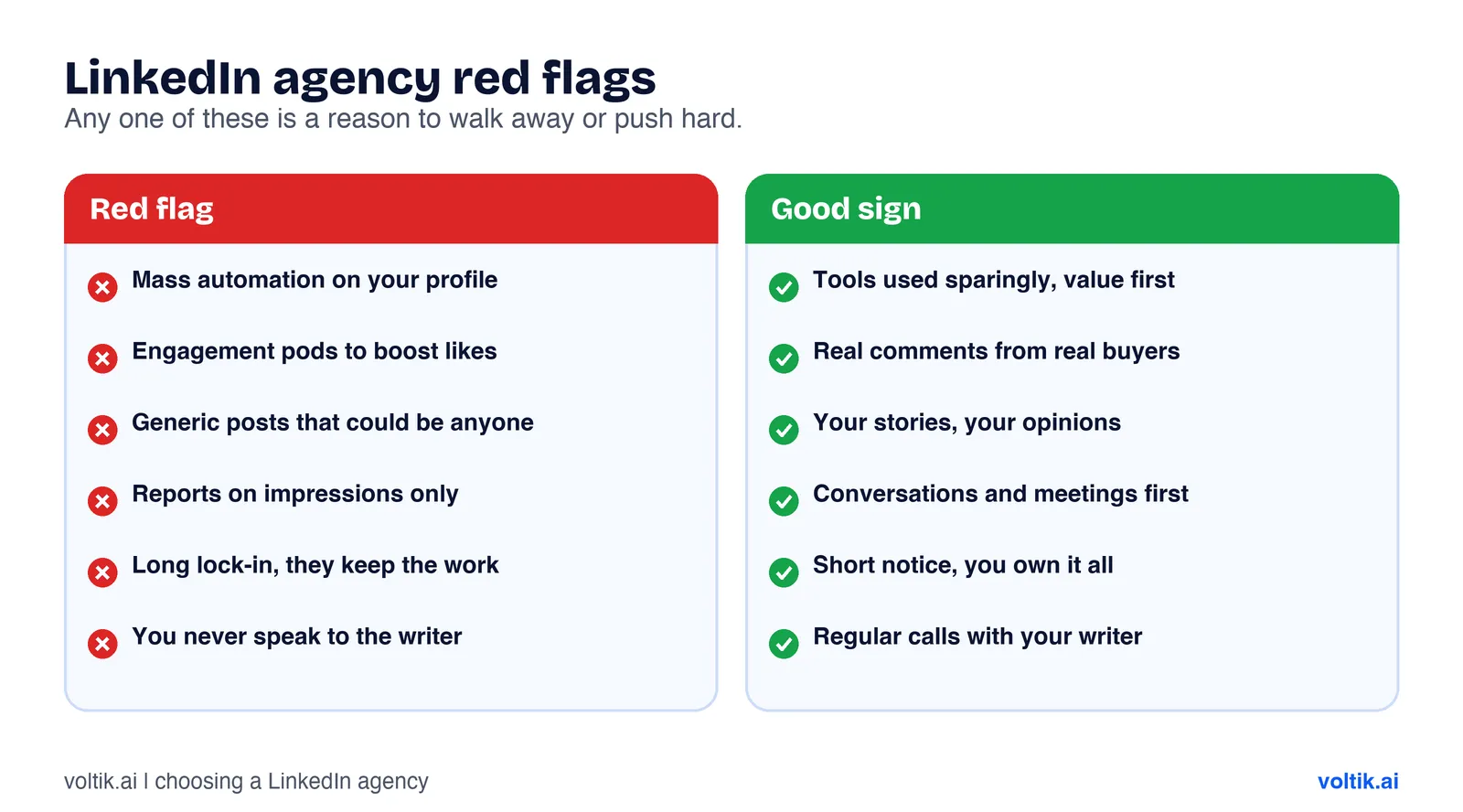 Six warning signs, and what to look for in their place.
1. Mass automation on your profile. Tools set to blast hundreds of connection requests, auto-like posts or send long message sequences while you sleep. LinkedIn’s help pages say accounts that use prohibited automation risk being restricted or shut down. In our experience, the accounts that get into trouble are the ones pushed hardest. If an agency uses any outreach tool at all, it should be used selectively: small daily numbers, a list a person has checked, and messages written for the reader. Ask exactly what runs on your account, and at what pace.
2. Engagement pods. A group that agrees to like and comment on each other’s posts. The numbers look good. The likes come from other clients and other agencies, and those people will never buy from you.
3. Generic AI posts. Posts with a hook line, a list of one-sentence paragraphs and a question at the end, with no story only you could tell. Your buyers have seen hundreds. Our guide on how to write LinkedIn posts that don’t sound like AI shows what to look for.
4. Vanity metrics only. A monthly report full of impressions, followers and likes, with no mention of who engaged, who replied or what meetings came from it. Impressions are easy to grow and hard to bank.
5. Lock-in. Twelve-month minimum terms, a notice period of several months, or content and outreach lists that stay with the agency when you leave.
6. No access to the account owner. You meet a senior person in the pitch. After that, a junior writes from a brief and you never speak again. A voice cannot be copied from a brief.
Which questions should you ask, and what do good answers sound like?
Our general guide on how to choose a marketing agency has 25 questions for any agency, covering team, plan, measurement, ownership and money. Use it as well. The questions below are only about LinkedIn.
“How do my posts get published, and who logs in?” Good: “You approve every post before it goes out. If we need access for outreach, we agree in writing what we do, how often, and how we keep your account safe.” Bad: “Just send us your login and leave it to us.”
“Do you use any automation tools, extensions or pods?” Good: “Never pods. If we use an outreach tool, we use it selectively: small daily numbers, lists a person has checked, every message written for the reader, and we slow down at the first warning sign.” Bad: “Our tool sends hundreds of requests a week and it is totally safe.” Or a pause, then a change of subject.
“How will you learn my voice?” Good: “A long first interview, then short calls each week or two. We record them and write from your own words. You will see a sample before you commit.” Bad: “Fill in this questionnaire and we will take it from there.”
“Who will I speak to each week?” Good: a named writer, with a regular call in the diary. Bad: “Your account manager will pass on any feedback.”
“What will you report each month?” Good: “Conversations started with people who fit your buyer list, meetings booked, inbound messages and who they came from. Reach is in there as a side note.” Bad: “Impressions, followers, engagement rate and your SSI.”
“How do you use AI?” Good: a clear, honest answer, such as using it to transcribe calls or tidy notes, with a person writing and editing every post. Bad: “We don’t use AI at all” from a team that writes for dozens of founders, or “Our AI writes it in your style.”
“What happens if I want to stop?” Good: “A short notice period. You keep every post, draft, interview recording and contact list.” Bad: “The minimum term is twelve months.”
“Who should not hire you?” Good: a specific answer. Every honest agency has one. Bad: “We can help anyone.”
How should you score the agencies on your shortlist?
Ask the questions above in writing, then use the call to push on weak answers. Score each line 0, 1 or 2 and add them up.
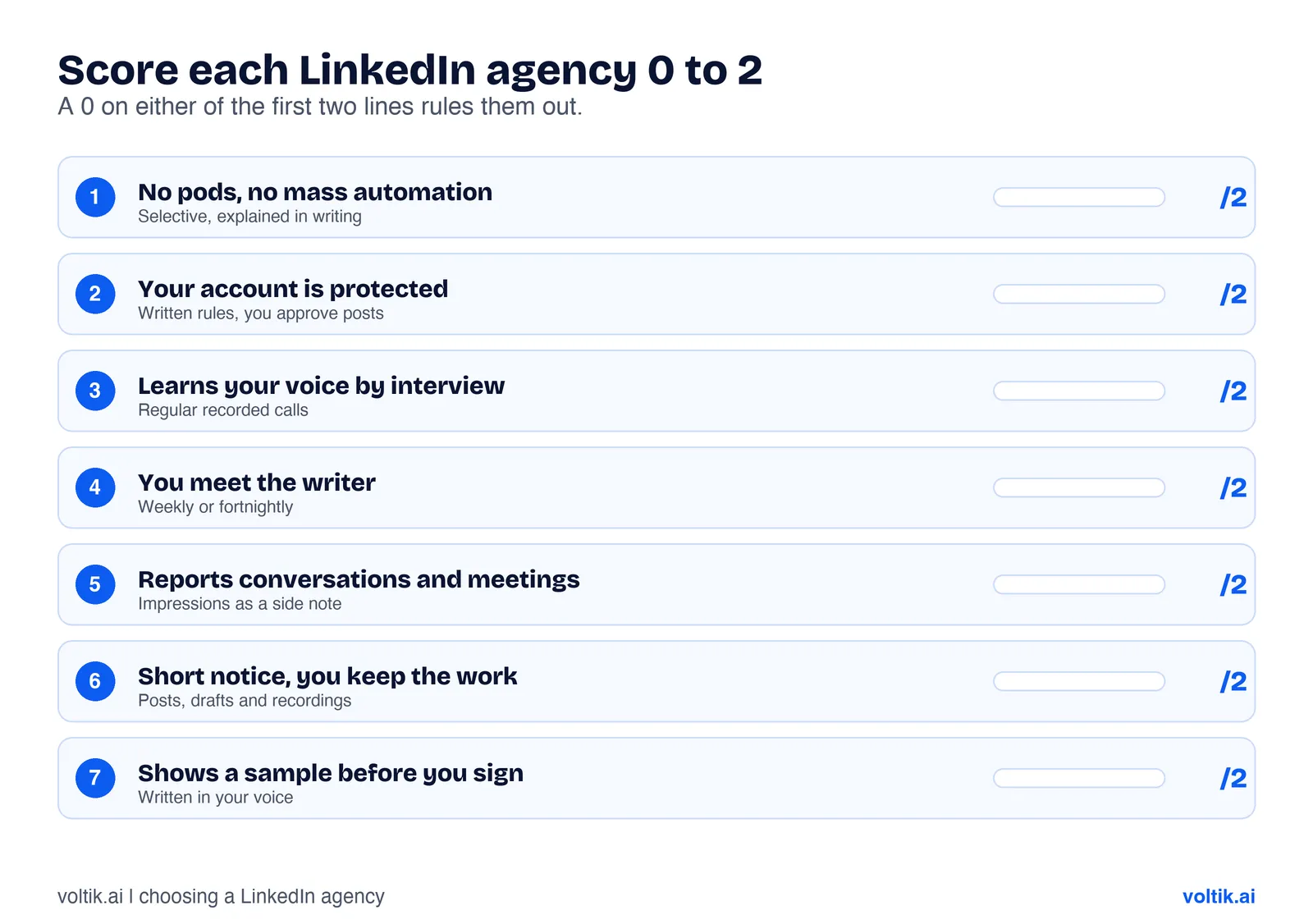 Copy this into a spreadsheet and score every agency on the same lines.
| Check | 0 | 1 | 2 |
|---|---|---|---|
| No pods, no mass automation | Pods or volume blasts | Vague answer | Selective, explained in writing |
| Your account is protected | Wants your login, no rules | Unclear | Clear written rules, you approve posts |
| Learns your voice by interview | Questionnaire only | One kick-off call | Regular recorded calls |
| You meet the writer | Never | Now and then | Weekly or fortnightly |
| Reports conversations and meetings | Impressions only | Some of both | Leads with buyer outcomes |
| Short notice, you keep the work | Long lock-in | Some limits | Short notice, you own it all |
| Shows a sample before you sign | Refuses | Old samples only | A sample in your voice |
Our rule of thumb: a 0 on either of the first two lines rules an agency out, whatever the total. Below 9 out of 14, keep looking.
What should you expect in the first 90 days?
Being known on LinkedIn takes time. In our experience, the first month is setup, the second is rhythm and the third is when the first real conversations usually start. That is a pattern we see, with no promise attached.
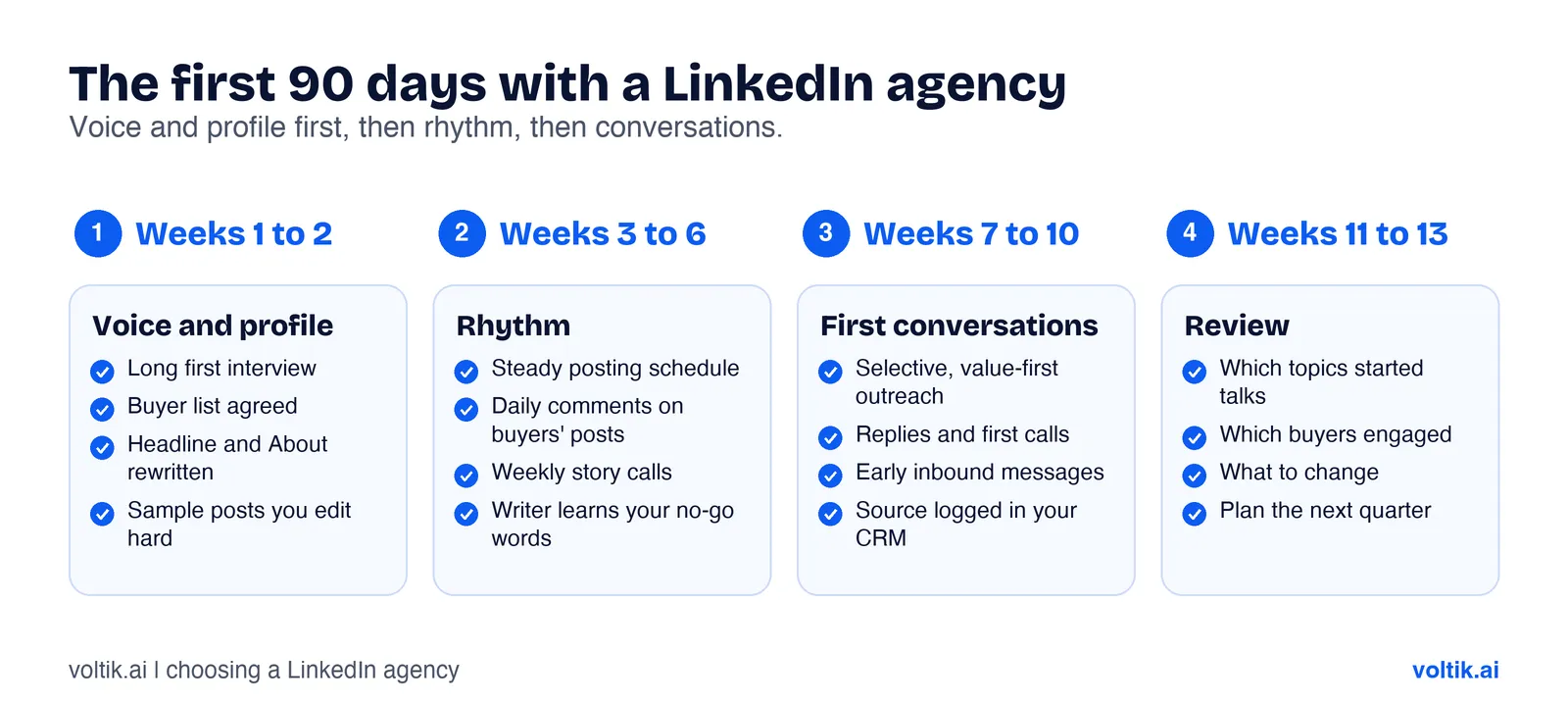 Voice and profile first, then rhythm, then conversations.
Weeks 1 to 2: voice and profile. A long interview about your work, your clients’ problems and your opinions. A list of the buyers you want to reach. A rewritten headline, About section and Featured links. A handful of sample posts you edit hard.
Weeks 3 to 6: rhythm. Posting on a steady schedule you can keep. A short daily habit of commenting on your buyers’ posts. Weekly calls to collect new stories. The writer learns what you would never say.
Weeks 7 to 10: first conversations. Human outreach to people who engaged with your posts or fit your buyer list. Replies, a few calls, and the first inbound messages from people you did not contact.
Weeks 11 to 13: review. What topics started conversations? Which buyers engaged? What should change? Decide on the next quarter with real evidence.
Common mistake: judging the agency on week three. Early posts often get modest reach, while the account and the voice find their feet.
How should you measure a LinkedIn agency?
Measure what you would tell your board. Three numbers matter most.
Conversations with the right people. Count direct messages and comment threads with people on your buyer list or who match it. Ten talks with heads of finance at your target firms beat a thousand likes from other marketers.
Meetings booked. Calls that came from LinkedIn, with a note of the post, comment or message that started them. Ask people “how did you hear about us?” and write the answer in your CRM.
Inbound from the right people. Messages, form fills and referrals that mention your LinkedIn activity. These are slow to start and often the best sign the work is landing.
Impressions and followers can sit lower in the report as context. Be careful with the Social Selling Index too. LinkedIn describes it as a score from 0 to 100 for how well social sellers build a brand, find prospects, engage and build relationships. On the same page, LinkedIn says a high score doesn’t always correlate with measurable sales outcomes. If an agency reports it as proof of success, ask what else they have.
Our piece on vanity metrics vs revenue metrics goes deeper on this.
Is ghostwriting honest, and how do you keep your real voice?
Plenty of busy leaders get help with their writing, and we see nothing wrong with that on its own. On LinkedIn, we think it stays honest when three things are true.
- The ideas are yours. The stories, opinions and lessons come from you, in interviews. The writer shapes them. Nothing is invented: no fake client stories, no made-up numbers, no opinions you do not hold.
- You approve every word. Nothing goes out under your name that you have not read and agreed to.
- You do the talking. Replies to comments and direct messages come from you, or are clearly agreed with you. When someone thinks they are talking to you, they should be.
To keep your voice, give the writer raw material. Record your calls, forward your voice notes, share the emails you are proud of. Tell them the phrases you hate. Edit the first drafts heavily, because that is how they learn. If you stop recognising yourself in the posts after a month, say so early.
For teams, the same rules apply to each person. Our guide to founder and team LinkedIn branding for professional services covers how to run it across several people.
Where Voltik fits, and when we are the wrong choice
We run LinkedIn personal branding for founders, partners and senior teams at UK service firms. We interview you, write in your voice, help with the profile and commenting, and run outreach that leads with value. We never use engagement pods, and any outreach tool is used selectively, at a careful pace, with messages written for each person. Because we also build websites and run SEO and ads, we can connect LinkedIn to the page a buyer lands on and the follow-up after they enquire.
We suit you if you have real expertise and opinions, you can give us a short call most weeks, you sell to a defined group of buyers, and you care more about the right conversations than big numbers.
We are the wrong choice if you want a high volume of automated connection requests, you want posts without being involved, you need a large in-house content team across many languages, or you want guaranteed leads by a set date. Nobody can honestly promise that on LinkedIn, and we do not.
Questions people ask
What does a LinkedIn agency do?
It helps a founder or team grow their reputation on LinkedIn. Usually that means positioning, profile rewrites, ghostwritten posts, comments and human outreach to the right buyers.
Is it against LinkedIn’s rules to use a ghostwriter?
We found no rule against getting help writing your posts. LinkedIn’s rules focus on bots, automation, fake engagement and account sharing. Approve every post that goes out under your name.
Can a LinkedIn agency get my account banned?
It can put your account at risk. LinkedIn’s help pages say members who use prohibited automation software or extensions risk having their accounts restricted or shut down. In our experience the risk rises with volume, which is why any tool should be used selectively and slowly.
What is an engagement pod?
A group that agrees to like and comment on each other’s posts. LinkedIn’s Professional Community Policies say not to agree ahead of time to like or re-share each other’s content.
How long before LinkedIn work shows results?
In our experience, expect voice and rhythm in the first two months and the first real conversations around the third. It varies with your market and how involved you are.
What should a LinkedIn agency report each month?
Conversations with the right people, meetings booked and inbound from buyers you want. Treat impressions and followers as background.
Sources
- LinkedIn, “User Agreement”, sections 2.1, 2.2 and 8.2 (effective 3 November 2025), linkedin.com/legal, accessed November 2026.
- LinkedIn, “Professional Community Policies”, linkedin.com/legal, accessed November 2026.
- LinkedIn, “Prohibited software and extensions”, LinkedIn Help, accessed November 2026.
- LinkedIn, “Automated activity on LinkedIn”, LinkedIn Help, accessed November 2026.
- LinkedIn, “The Social Selling Index (SSI)”, LinkedIn Sales Solutions, accessed November 2026.
Want a LinkedIn partner who writes like you?
If you want to be known by the right buyers without risking your account or sounding like a template, see how our LinkedIn personal branding service works. Or book a free call and we will look at your profile and tell you honestly whether we are the right fit.
Work with us